
This is Mount Everest, the iconic peak of the Himalayas, located on the border between Nepal and China. The Himalayan mountain range stretches across nearly 2,400 kilometers, starting from northern Pakistan and extending through India, Nepal, China, and Bhutan.
Mount Everest is widely known as the highest mountain in the world, and thousands of climbers attempt to reach its summit every year. Sadly, many have also lost their lives in this dangerous pursuit.
However, modern science reveals a surprising fact: Mount Everest is not the highest point on Earth by every scientific measurement. The method traditionally used to measure height is now considered incomplete.
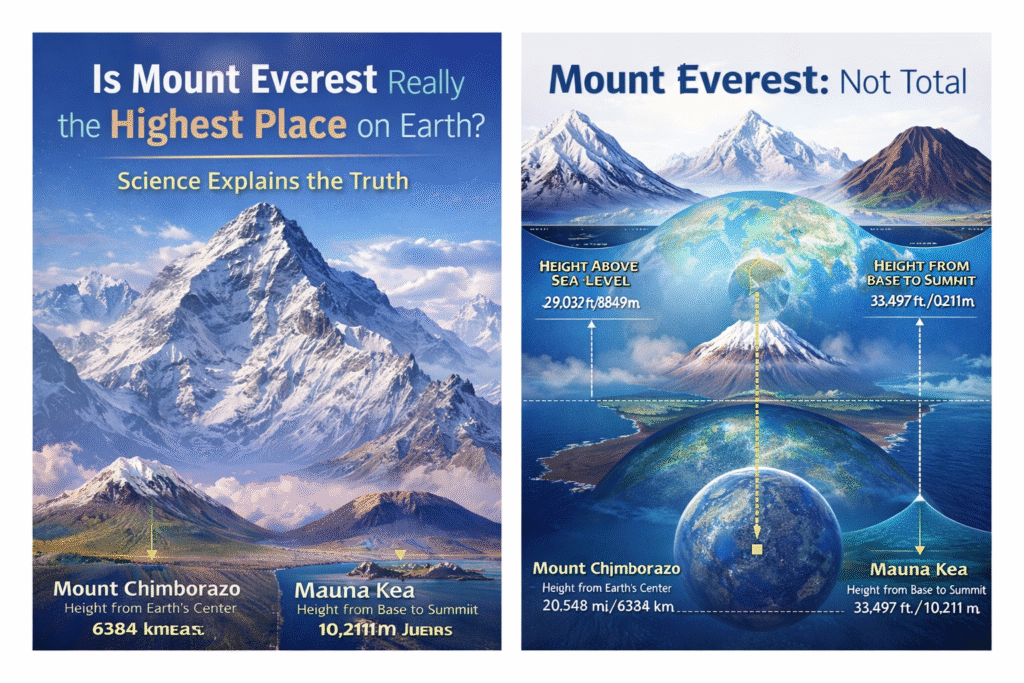
Why Is Mount Everest Not Always the Tallest Mountain?
If Mount Everest is not always the highest, then which mountain is? And how do scientists measure the height of mountains?
To understand this, we first need to explore the different ways mountain height can be measured.
How Is the Height of a Mountain Measured?
There are three main scientific methods used to measure the height of mountains.
Method 1: Height Above Sea Level
The most common method measures a mountain’s height from mean sea level, also known as elevation.
For a long time, people believed that sea level was the same everywhere. However, scientific research has shown that sea level varies due to factors such as Earth’s shape, gravity, ocean currents, and climate change.
Today, NASA satellites are used to measure sea level accurately across the globe.
Using this method, Mount Everest stands at 29,030 feet (8,849 meters) above sea level, making it the highest mountain by elevation.
Mount Everest was first climbed in 1953, but its height was calculated almost a century earlier in 1856 by British surveyor Andrew Scott and his team. Using triangulation techniques, they measured the mountain multiple times and averaged the results to determine its height.
Method 2: Distance from the Center of the Earth
The second method measures the distance from the Earth’s center to the mountain’s summit.
The Earth is not a perfect sphere. Due to its rotation, it bulges at the equator because of centrifugal force. This makes locations near the equator farther from Earth’s center.
Mount Chimborazo, located in Ecuador in South America, lies just one degree south of the equator. Although it is only 6,268 meters above sea level, its summit is farther from the Earth’s center than Mount Everest.
The distance from Earth’s center to Mount Chimborazo’s summit is approximately 6,384 kilometers, while Mount Everest’s summit is about 6,382 kilometers away.
By this measurement, Mount Chimborazo is actually the highest point on Earth.
Method 3: Height from Base to Summit
The third method measures a mountain from its base to its peak, regardless of sea level.
Using this method, Mauna Kea in Hawaii becomes the tallest mountain in the world. Although it rises only 4,200 meters above sea level, most of the mountain lies underwater.
When measured from its base on the ocean floor to its summit, Mauna Kea stands approximately 10,211 meters tall—far taller than Mount Everest, whose base-to-peak height is about 4,700 meters.
Highest Mountains in Pakistan
Pakistan is home to some of the world’s tallest mountains. K2 is Pakistan’s highest peak, standing at 8,611 meters above sea level, making it the second-highest mountain in the world by elevation.
Another significant peak is Nanga Parbat, which rises to 8,126 meters above sea level. According to scientists, Nanga Parbat continues to grow at a rate of about 0.27 inches per year due to tectonic activity.
Which Mountain Is Truly the Highest?
So, is the world’s highest mountain Mount Everest, Mount Chimborazo, or Mauna Kea?
The answer depends entirely on how you define “height”:
- Height above sea level: Mount Everest
- Distance from Earth’s center: Mount Chimborazo
- Base-to-summit height: Mauna Kea
Conclusion
There is no single correct answer to which mountain is the highest on Earth. It all depends on the method used to measure height.
Which method do you think makes the most sense? Height above sea level, distance from Earth’s center, or base-to-summit measurement?
Share your thoughts in the comments, and don’t forget to subscribe for more fascinating educational content.
Published by DailyUpDown
This article is for educational and informational purposes only.
Frequently Asked Questions (FAQ)
Q1: Is Mount Everest the highest mountain in the world?
Mount Everest is the highest mountain when measured from sea level. However, it is not the highest by every scientific measurement.
Q2: Which mountain is farthest from the center of the Earth?
Mount Chimborazo in Ecuador is the farthest point from Earth’s center due to the planet’s equatorial bulge.
Q3: What is the tallest mountain from base to summit?
Mauna Kea in Hawaii is the tallest mountain when measured from its base on the ocean floor to its summit.
Q4: Why does Earth’s shape affect mountain height measurements?
Earth is not a perfect sphere. Its rotation causes a bulge at the equator, which makes equatorial mountains farther from the planet’s center.
Q5: What is Pakistan’s highest mountain?
K2 is Pakistan’s highest mountain and the second-highest mountain in the world by elevation above sea level.
Q6: Why do scientists use different methods to measure mountain height?
Different measurement methods help scientists understand Earth’s shape, geology, and tectonic movements more accurately.
References and Further Reading
This article is based on scientific research and publicly available geographical data. For readers who want to explore this topic further, the following sources provide reliable background information:
Mount Everest – Wikipedia
https://en.wikipedia.org/wiki/Mount_Everest
Mountain Elevation – Wikipedia
https://en.wikipedia.org/wiki/Elevation
Chimborazo – Wikipedia
https://en.wikipedia.org/wiki/Chimborazo
Mauna Kea – Wikipedia
https://en.wikipedia.org/wiki/Mauna_Kea
Himalayas – Wikipedia
https://en.wikipedia.org/wiki/Himalayas
K2 – Wikipedia
https://en.wikipedia.org/wiki/K2