
Around the world, countries follow different systems of governance. Some operate under federal parliamentary systems, others under presidential systems, while some are governed as a single administrative unit.
In many countries, effective governance is achieved by dividing the state into smaller administrative units such as provinces, states, regions, or counties. Pakistan has faced governance challenges for decades, and many experts now believe the time has come to decentralize power by creating smaller provinces.
Why Are New Provinces Needed in Pakistan?
The core idea behind creating new provinces is to bring governance closer to the people. Smaller administrative units allow authorities to respond more effectively to local issues and improve service delivery in areas such as education, healthcare, and infrastructure.
Despite repeated political promises, Pakistan has remained limited to four provinces, raising important questions about governance efficiency and regional development.
Historical Background of Administrative Division in Pakistan
At the time of independence in 1947, British India consisted of 17 provinces and hundreds of princely states. Out of these, Sindh, the North-West Frontier Province, and Balochistan became part of Pakistan, while Punjab and Bengal were divided on religious lines.
Pakistan initially emerged as a two-wing country, consisting of East Pakistan and West Pakistan. West Pakistan included Punjab, Sindh, NWFP, and Balochistan, along with 13 autonomous princely states.
States such as Bahawalpur, Khairpur, Kalat, Lasbela, and Kharan were later merged into different provinces. Other regions, including Swat, Dir, Chitral, and Hunza, were incorporated into the administrative structure over time.
Comparison with Other Countries
Soon after independence, India realized that effective governance required administrative decentralization. Today, India has 28 states and 8 union territories, with the process of creating new administrative units still ongoing.
In contrast, Pakistan has remained administratively stagnant. According to global governance rankings, India ranks significantly higher than Pakistan. Bangladesh, which separated from Pakistan in 1971, is divided into eight administrative divisions and also ranks higher in governance indicators.
Even Afghanistan has 34 provinces, while Iran has 31. These comparisons highlight the link between administrative division and governance efficiency.
Governance and Administrative Efficiency
Countries that rank high in global governance indexes tend to have smaller and more manageable administrative units.
South Korea, ranked among the top countries in governance, has nine provinces despite being much smaller than Pakistan in both area and population. Switzerland, another highly ranked country, consists of 26 cantons, even though its population and size are far smaller than Pakistan’s.
Similarly, countries like Denmark, Sweden, Germany, and Japan have more administrative units despite having smaller populations and territories.
Population and Area Imbalance in Pakistan’s Provinces
Punjab, Pakistan’s most populous province, has over 110 million people—more than the population of many countries such as Germany, France, and the United Kingdom.
Balochistan, on the other hand, is geographically massive, covering more than 347,000 square kilometers, making it larger than many countries including Italy and Malaysia.
This imbalance creates governance challenges and contributes to unequal development across regions.
Impact of Not Creating New Provinces
The lack of administrative restructuring has resulted in uneven development. Regions such as Balochistan, South Punjab, and interior Sindh continue to lag behind in education, healthcare, infrastructure, and employment opportunities.
Poverty levels in South Punjab exceed 43 percent, compared to the provincial average of around 28 percent. Despite its population size, the region historically received a disproportionately small share of development funding.
Similar concerns exist in Sindh, where urban centers like Karachi contribute significantly to the national economy but face governance and representation challenges.
Political Resistance to New Provinces
The main obstacle to creating new provinces is political resistance. Power, budget control, and administrative authority are often concentrated in provincial capitals, making political elites reluctant to support decentralization.
For example, the creation of a South Punjab province would reduce administrative control from Lahore, which many political stakeholders oppose.
Ethnic and linguistic concerns further complicate the debate, as proposals are often perceived through the lens of identity politics rather than administrative efficiency.
Proposed New Provinces in Pakistan
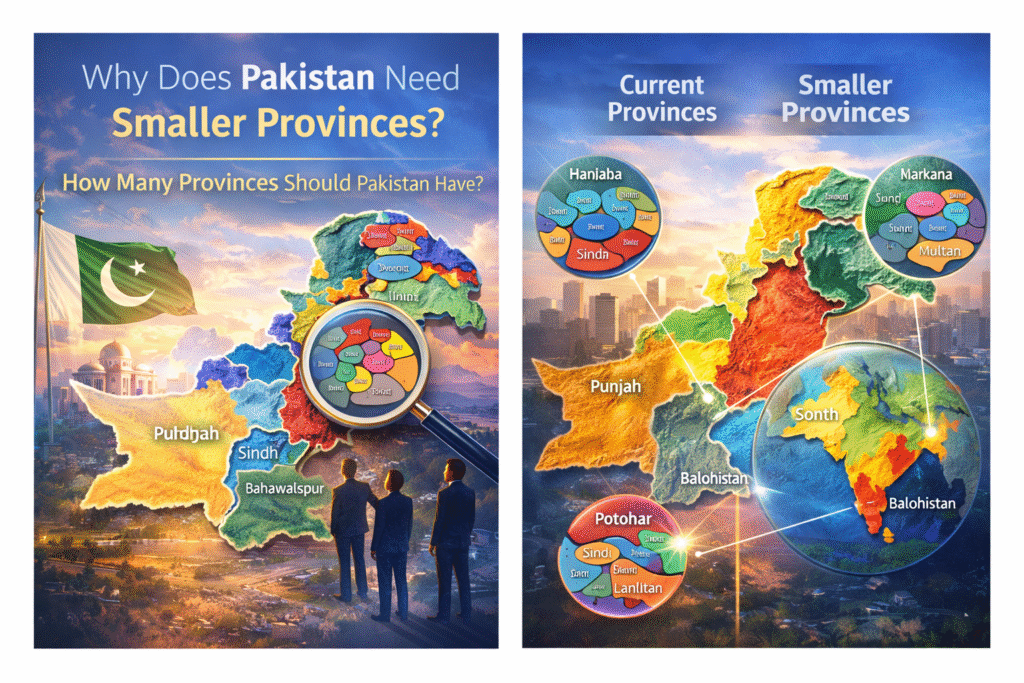
Experts suggest that Pakistan could function more effectively with 14 to 16 provinces. This would require restructuring existing provinces based on administrative efficiency rather than ethnicity or language.
In Punjab, proposals include:
- A Potohar province
- A Central Punjab province
- A South Punjab or Multan province
- Restoration of Bahawalpur as a separate province
Bahawalpur, once a princely state, has a population of over 12 million and a strong administrative history prior to its merger under the One Unit system.
Sindh, Balochistan, and Khyber Pakhtunkhwa Proposals
In Sindh, Karachi could be designated as a separate province, while interior regions could be reorganized into two additional provinces.
Balochistan could be divided into two provinces to improve governance across its vast territory.
Khyber Pakhtunkhwa also has the capacity for multiple provinces, including:
- A Hazara province
- A southern province based on Dera Ismail Khan and Bannu
- A central province covering Peshawar, Mardan, and Kohat
Constitutional and Political Challenges
Creating new provinces requires a two-thirds majority in parliament, a threshold no single political party has been able to achieve in recent elections.
Additionally, disagreements over resource distribution, ethnic identity, and political trust continue to delay meaningful progress.
Conclusion
Administrative division is not a threat to national unity but a tool for better governance. Smaller provinces can improve service delivery, reduce inequality, and strengthen democratic accountability.
The real question is not whether Pakistan needs new provinces, but whether political leadership is willing to prioritize governance over personal and political interests.
What is your opinion on creating new provinces in Pakistan? Do you agree with these proposals, or do you have alternative ideas? Share your thoughts in the comments.
Published by DailyUpDown
This article is for educational and informational purposes only.
Frequently Asked Questions (FAQ)
Q1: Why does Pakistan need smaller provinces?
Smaller provinces help bring governance closer to the people, improve service delivery, and reduce administrative overload in large regions.
Q2: How many provinces should Pakistan ideally have?
According to various governance experts, Pakistan could function more efficiently with around 14 to 16 provinces based on population and administrative needs.
Q3: What is the biggest obstacle to creating new provinces?
The main challenges are political resistance, constitutional requirements, and disagreements over resource distribution and power sharing.
Q4: Can new provinces improve development and governance?
Yes, international examples show that smaller administrative units often lead to better governance, improved infrastructure, and more balanced regional development.
Q5: Is the creation of new provinces based on ethnicity?
Ideally, new provinces should be created on administrative and governance grounds, not on ethnic or linguistic identity.
Q6: Does the Pakistani constitution allow the creation of new provinces?
Yes, the constitution allows it, but it requires a two-thirds majority in parliament, which has been difficult to achieve.
References and Further Reading
This article is based on governance studies, demographic data, and publicly available research. For readers who want to explore the topic of administrative division and governance in Pakistan in more detail, the following sources provide reliable background information:
Federalism – Wikipedia
https://en.wikipedia.org/wiki/Federalism
Provinces of Pakistan – Wikipedia
https://en.wikipedia.org/wiki/Provinces_of_Pakistan
Administrative divisions of Pakistan – Wikipedia
https://en.wikipedia.org/wiki/Administrative_units_of_Pakistan
States and territories of India – Wikipedia
https://en.wikipedia.org/wiki/States_and_union_territories_of_India
Governance – Wikipedia
https://en.wikipedia.org/wiki/Governance
Bahawalpur State – Wikipedia
https://en.wikipedia.org/wiki/Bahawalpur_State